



Azo Smart, producing more with less
Azo Smart: produce more with less. The microbial technology at the heart of the new agriculture
Modern agriculture is facing a profound transformation. Over the past decade, global events such as the pandemic, geopolitical tensions and increasing climate instability have generated significant repercussions on the balance of agricultural markets and on the availability of technical inputs required for production. The growth of the world population, increasing climate variability and the need to preserve natural resources are redefining the way agricultural production systems are conceived.
In this scenario, crop nutrition plays a more strategic role than ever. Farmers are required to ensure high and high-quality yields while at the same time reducing environmental impact and improving the efficiency of technical inputs. Among these, nitrogen undoubtedly represents one of the most decisive elements for agricultural productivity.
Nitrogen is in fact the main driver of plant growth, as it is involved in the synthesis of proteins, enzymes, chlorophyll and numerous metabolites essential for plant development. However, in modern agricultural systems a significant portion of the nitrogen applied is not fully utilized by crops. Processes such as volatilization, leaching and immobilization can significantly reduce the efficiency with which this nutrient is used.
For this reason, in recent years agronomic research has increasingly focused on the concept of Nitrogen Use Efficiency (NUE), namely the ability of crops to use available nitrogen more efficiently, maximizing productivity while reducing losses within the soil–plant–atmosphere system.
In this context, biological and microbiological innovation is emerging as one of the most promising strategies for improving the nutritional efficiency of crops.
Microbiology applied to plant nutrition
In natural ecosystems, microorganisms play a fundamental role in the biogeochemical cycles of nutrients. In particular, many bacteria and fungi are able to actively participate in the transformation processes and availability of nutrients essential for plants.
Among these, nitrogen-fixing microorganisms play a particularly important role, as they are able to convert atmospheric nitrogen into forms that can be assimilated by plants. This biological process, known as biological nitrogen fixation, represents a fundamental component of the nitrogen cycle in terrestrial ecosystems.
In addition to nitrogen fixation, many beneficial microorganisms (PGPR) are able to produce bioactive compounds, phytohormones and secondary metabolites that stimulate plant metabolism, improve root development and promote greater efficiency in nutrient uptake and utilization.
Scientific research has also shown that the use of microbial consortia, that is, combinations of different species with complementary functions, can amplify the beneficial effects on plant physiology compared to the use of single microorganisms. The simultaneous presence of multiple species makes it possible to activate different metabolic pathways and generate synergistic interactions that strengthen the overall effectiveness of the biological solution.
This knowledge has paved the way for the development of new microbiological technologies capable of supporting crop nutrition and improving the efficiency of production systems.
Microbiological innovation for nutritional efficiency
Within this framework of innovation lies Azo Smart, a technology developed by Agriges as part of the Green Path project, the company’s research and development program aimed at creating sustainable solutions for modern agriculture.
Azo Smart is a microbiological formulation designed to support crop nutrition through a selected consortium of functional microorganisms capable of contributing to nutritional efficiency and plant metabolism.
The solution is the result of extensive work in microbial selection and characterization carried out within an internationally registered microbial collection. The objective was to identify microorganisms with complementary characteristics capable of operating synergistically within the holobiont (plant system).
The application of the formulation allows crop nutritional processes to be integrated through the biological activity of microorganisms, helping to improve nitrogen use efficiency while supporting the physiological development of the plant.
The microbiological consortium of Azo Smart
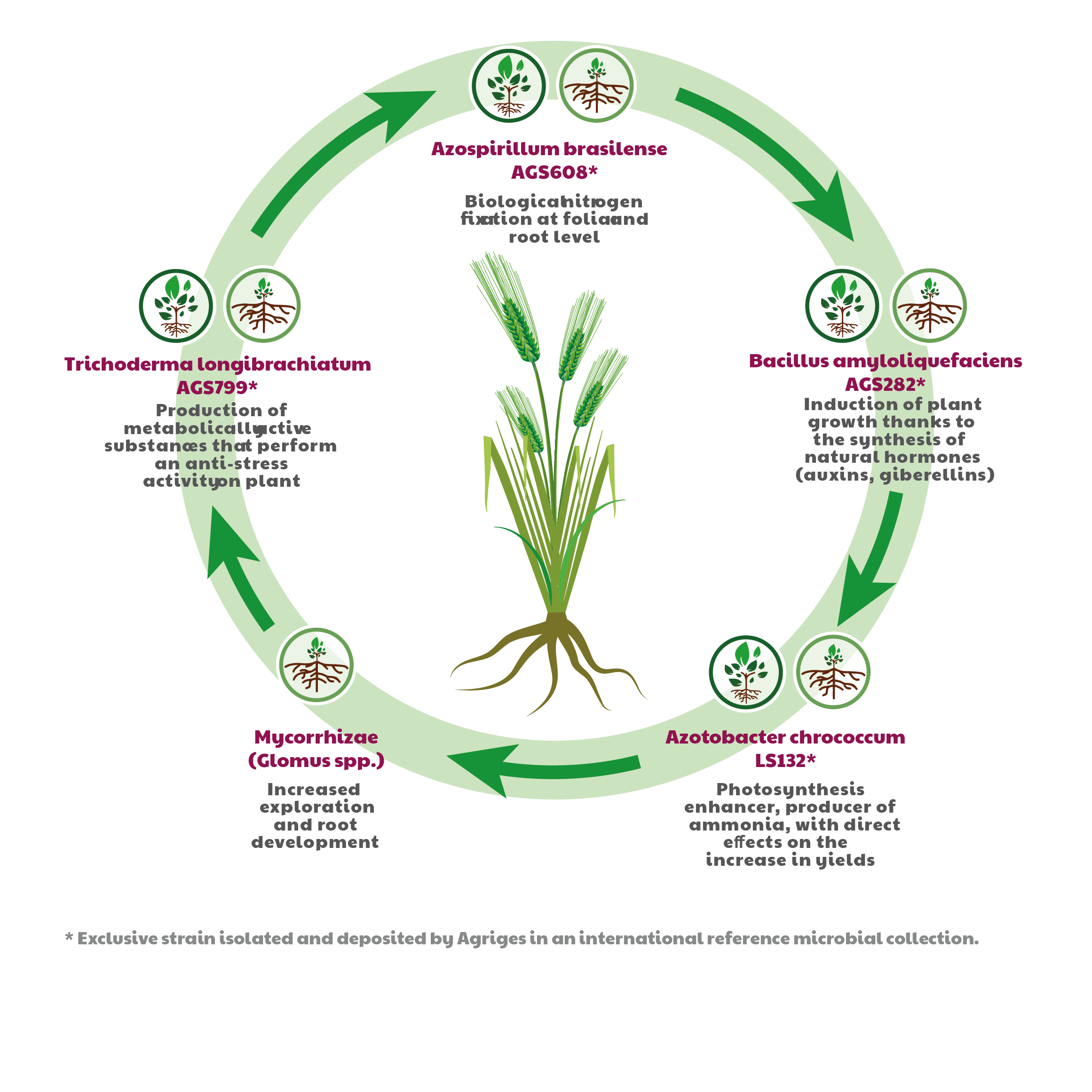
Azo Smart technology is based on a consortium composed of microorganisms carefully selected for their functional properties.
Among these are:
Azotobacter chrococcum LS132
A free-living nitrogen-fixing bacterium capable of converting atmospheric nitrogen into biologically available forms. Its activity helps integrate nitrogen nutrition in crops and improve the plant’s metabolic efficiency.
Azospirillum brasiliense AGS 608
A microorganism known for its ability to promote plant growth through the production of phytohormones and bioactive compounds. It supports root system development and contributes to biological nitrogen fixation.
Bacillus amyloliquefaciens AGS 282
A plant growth-promoting bacterium (PGPR) capable of stimulating plant physiological activity and improving responses to environmental stress through the production of bioactive metabolites.
Trichoderma longibrachiatum AGS 799
A fungus characterized by high adaptability and strong colonization ability within the plant environment. It contributes to strengthening plant vitality and improving nutritional efficiency.
Mycorrhizae of the genus Glomus
Symbiotic fungi that enhance nutrient absorption and contribute to improving the physiological balance of plants.
The combined action of these microorganisms activates several biological mechanisms that support crop nutrition, improving nutrient use efficiency and contributing to plant vitality.
Towards increasingly efficient and sustainable nutrition
The challenges of modern agriculture require solutions capable of combining productivity, sustainability and efficiency in resource use. In this context, the integration of biological and microbiological technologies represents one of the most promising frontiers for agronomic innovation.
Enhancing the activity of microorganisms means harnessing natural processes that can help improve crop physiology, increase nutritional efficiency and support agricultural productivity in a more sustainable way.
With the development of solutions such as Azo Smart, Agriges continues its commitment to promoting an agriculture capable of integrating scientific research and technological innovation, guiding farmers towards increasingly efficient and resilient production systems.
In line with the Green Path philosophy, the objective remains clear: produce more while using fewer resources, enhancing the potential offered by microbiology applied to plant nutrition.
For more information on the product download the brochure